Can I use children's images in party rental ads?
What weighs on showing children in inflatable rental ads: account risk, image release, and alternatives that still convert.

In short Showing children in party ads is the sector's biggest fear, for a concrete reason: for most rental companies Instagram is effectively the whole client pipeline, and an account blocked at a severe level can take months to return. The route the sector takes is not dropping children from communication, but moving them out of paid ads — keeping them on the organic profile, with written permission.
Figures measured by L2 Mídias
- Meta account block levels and recovery time
- Level 1 resolves with document verification in around 5 to 10 days; level 3 can take months to years, with cases considered unrecoverable for advertising Jul 2025 to Jul 2026
- Dependence on Instagram as a revenue channel in party rentals
- Without paid traffic, client origin is typically ~50% referral and ~50% organic Instagram, reaching 70% referral in some operations Jul 2025 to Jul 2026
- Impact of losing the profile and starting over
- Tracked case of a profile blocked for a policy restriction: previous account had over 1,300 followers, new profile restarted with just over 200 Jul 2025 to Jul 2026
This is one of the most frequent questions in meetings with rental owners, and it usually arrives exactly like this: “how far can we go using a child’s image? Can we show a little hand, a foot, can we use the child’s actual face, the child playing?”
Whoever asks is not being excessively cautious. They are protecting the only client pipeline they have.
Context: figures and practices below come from the Brazilian market.
Why the fear is proportional
In a party rental company without paid traffic, client origin is typically half referral and half organic Instagram — in some operations, 70% referral. Which means the profile is not one marketing channel among others: for much of the sector, it is the business.
The sentence that captures it came up in a meeting: “if our profile falls, we will not be able to pay you.” And another, from an owner who had been through it: “how do I survive without Instagram until I get a court order?”
The risk, when it materialises, has a known size:
| Block level | Time to return |
|---|---|
| Lighter | Document verification, ~5 to 10 days |
| Severe | Months to years |
| Extreme cases | No return for advertising |
And there is a cost the table does not show: one tracked case had a profile blocked for a policy restriction, and an account with over 1,300 followers restarted with just over 200. Reach returns; the base built over years does not.
There is also the early-block case — “first campaign, second day, the account was blocked” — which usually has a different and more mundane cause, worth knowing before blaming the creative.
The two layers of risk, routinely confused
Layer 1 — the platform. What triggers ad review is rarely the child alone. It is the combination of a child with a direct commercial call in a paid ad. The same video that runs fine on the organic profile enters a different review track once it becomes an ad, because advertising involving minors receives stricter treatment.
Layer 2 — the release. An identifiable child’s image in a commercial context requires written permission from whoever holds guardianship. That applies regardless of platform, and regardless of the family having hired you. Hiring the service is not authorising the image in advertising.
Framing that does not identify — a hand, a foot, a child from behind, a silhouette — reduces layer 2. It does not remove layer 1.
A mistake mistaken for content censorship
A good share of blocks in the sector have nothing to do with children. They have to do with account configuration.
The most common case: two-factor authentication disabled, which surfaces as “you do not have permission to advertise” or “the account has advertising restrictions”. That is an account security problem, not a content one, and it is solved by enabling two-step verification.
Worth checking before rewriting every creative because of a block.
What the sector does in practice
The route most adopt is not abandoning children in communication. It is separating where they appear:
| Where | What tends to work |
|---|---|
| Paid ad | Assembled unit, finished space, decoration, setup before and after |
| Organic profile | The party running, children playing, behind the scenes — with permission |
| Social proof | Text or audio testimonial from the client, without their child’s image |
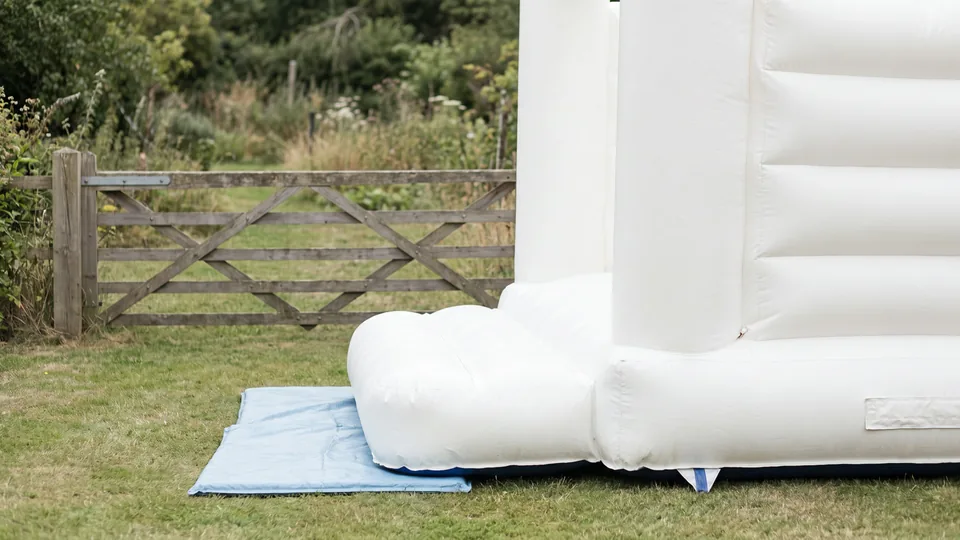
And it works for a reason beyond compliance: what sells in an ad is the expectation of how the party will look, and the assembled unit communicates that alone. The lit white castle, the play area arranged before doors open, the slide inflated in the garden — those answer the question the parent is asking, which is “how will my daughter’s party look”.
Children playing answers a different question, about trust, and that one is better answered on the profile and in testimonials.
Handling the release without awkwardness
The wrong moment to ask is after the party, with the video ready. The right one is before — and the right place is the rental contract.
A short image release clause, with a clear option to decline, settles three things at once: it puts the agreement in writing, avoids the uncomfortable conversation on the day, and separates who authorised from who did not before any material is produced.
- Does the contract include an image release clause?
- Does the clause allow declining without affecting the booking?
- Do I know which past parties have permission and which do not?
- Is paid-ad material separated from organic profile material?
- Is two-step verification active on the ad account?
- Is the ad account in my name, not a manager’s?
- Is there a backup profile or shared access, in case something falls?
- Have I consulted a lawyer about how this sits in my contract?
What this text is not
It is not legal advice. Use of children’s images involves Brazil’s Statute of the Child and Adolescent and data protection law, and how that enters your contract should go through a lawyer.
What is here is what sector operations report doing, what tends to go wrong, and the logic behind separating paid advertising from the organic profile — the most consistent practice among rental companies that have not lost an account.
The calculation that settles it
The question is not how likely the account is to fall. It is what happens to revenue if it does.
For anyone drawing half their clients from Instagram, the answer is a months-long stop in a business that already concentrates 90% of its volume on weekends and runs on a calendar that does not recover afterwards. Against that, swapping the child for the assembled unit in paid ads is a cheap trade — and in most cases it does not even cost conversion.
If the open question is what to put in the child’s place for the ad to keep converting, the creative decides your cost per lead lists the material that performs best in party rentals. The budget logic behind it is in ad budget for a party rental business, and the full cost structure in how much it costs to start a bounce house rental business.
Want these numbers applied to your rental business?
The data in this article comes from real operations we work with in Brazil. Leave your details and we will look at where yours is losing bookings.
Frequently asked questions
Can I show a child's face, or only a hand and a foot?
That is literally the question rental owners ask, and it has two layers. On the platform side, what tends to trigger review is not the child alone but the combination of a child with a direct commercial call in a paid ad. On the legal side, an identifiable child's image used commercially requires written permission from whoever holds guardianship. Framing that does not identify reduces the second risk; it does not remove the first.
Do I need permission even from a client who hired me?
Hiring the service is not the same as authorising use of the image in advertising. They are separate things, and the second has to be asked explicitly. The practice seen in organised operations is including an image release clause in the rental contract itself, with an option to decline — settling it before the party rather than after the video is posted.
If my account is blocked, how long until it returns?
It depends on severity. Lighter blocks usually resolve with document submission, in something between 5 and 10 days. Severe ones can take months, and some cases in practice never return for advertising. That is why the risk is not measured by how likely it is, but by what happens if it does — and for anyone drawing half their clients from Instagram, the answer is severe.
Is there an alternative that converts without children in the ad?
There is, and it is the route most operations end up adopting: the assembled unit, the finished space, the decoration, the before and after of setup, a text or audio testimonial from the client. What sells in an ad is the expectation of how the party will look, and the assembled unit communicates that on its own. Children playing works better on the organic profile, where the paid-ad review layer does not apply.
Is this legal advice?
No. This text describes practices and risks observed in the Brazilian party rental sector. Use of children's images involves Brazil's Statute of the Child and Adolescent (ECA) and data protection law, and how you handle this in your business should go through a lawyer. What is presented here is what operations report doing and what tends to go wrong.