How much it costs to start a bounce house rental business
Equipment investment, the real cost of each party, the margin that survives and how many events per month each size of operation sustains — Brazil.

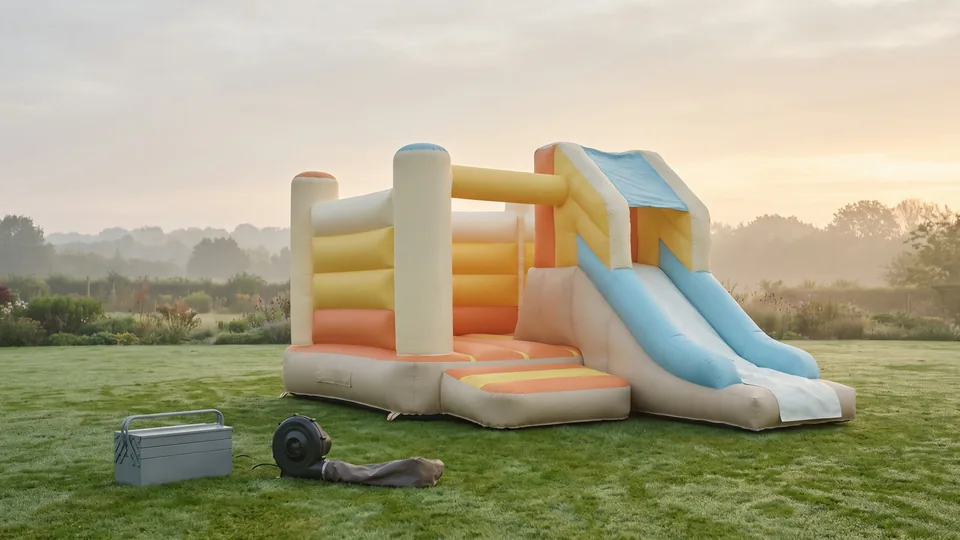
In short In the Brazilian market, starting a party rental business costs between R$6,000 and R$15,000 per colourful inflatable, and the return depends less on the unit than on the per-party maths: on a R$500 rental, the attendant, fuel and cleaning consume around R$200, leaving R$300. Typical sector margin runs from 34% to 40%, and what caps revenue is weekend capacity.
Figures measured by L2 Mídias
- Purchase investment per type of inflatable — Brazilian market
- Colourful inflatable R$6,000 to R$15,000; white luxury inflatable R$7,000 to R$15,000; soap football R$7,000 to R$20,000; mechanical bull ~R$40,000; foam cannon ~R$4,000 Jul 2025 to Jul 2026
- Operating cost of a R$500 party in the Brazilian rental market
- Attendant ~R$100, fuel ~R$50, cleaning and maintenance ~R$50 — around R$200 of cost and R$300 of gross profit Jul 2025 to Jul 2026
- Typical profit margin in the Brazilian party rental sector
- 34% to 40%; craft workshop packages can exceed 100% Jul 2025 to Jul 2026
- Monthly revenue by company size — Brazilian party rental
- Small R$4,000 to R$12,000/month; mid-sized R$15,000 to R$30,000; large R$40,000 to R$200,000 Jul 2025 to Jul 2026
- Events per month by operation size
- Small 4 to 6 events/month; mid-sized 10 to 20; large 30 to 70+ — almost always capped by logistics and staffing rather than demand Jul 2025 to Jul 2026
Anyone researching how much it costs to start a party rental business almost always gets the wrong answer: the price of the inflatable. The inflatable is the easy part of the calculation — it has a list price, an instalment plan and an invoice. What decides whether the business is profitable sits in the three lines that come after it, at every single party, and that rarely make it into the spreadsheet of someone starting out.
A note on the figures below: they come from the Brazilian market, in reais, gathered from rental owners of different sizes and regions. They are not manufacturer price lists or market estimates — they are what operations report actually practising.
What each unit costs to buy
| Equipment | Purchase investment |
|---|---|
| Colourful inflatable (castle, slide) | R$6,000 to R$15,000 |
| White luxury inflatable (Bubble House) | R$7,000 to R$15,000 |
| Soap football | R$7,000 to R$20,000 |
| Foam cannon | ~R$4,000 |
| Mechanical bull | ~R$40,000 |
| Trampoline | instalments of ~R$100/month |
The trampoline is the outlier: at around R$100 a month in instalments and renting between R$100 and R$300 per party, it usually pays for itself on the first or second booking of the month. That is why it shows up so often as the first piece of equipment.
The mechanical bull sits at the other end. Around R$40,000 up front for a unit whose demand concentrates in June and July, when Brazilian festa junina season pushes rental values into the R$1,500 to R$2,000 range. Outside that window, it occupies warehouse space.
What comes in per party
Investment only makes sense read against the ticket each piece sustains:
| Equipment | Rental per party (4 hours) |
|---|---|
| Ball pit | R$80 to R$300 |
| Trampoline | R$100 to R$300 |
| Colourful inflatable castle | R$200 to R$790 |
| Inflatable slide | R$250 to R$650 |
| Soap football | R$500 to R$1,500 |
| White castle | R$900 to R$1,090 |
| Bubble House / white luxury | R$1,100 to R$1,800 |
| Mechanical bull | R$800 to R$2,000 |
| Play area / kids space | R$450 to R$1,840 |
Two things this table hides and that matter more than it does: the standard rental is 4 hours (weddings tend to run 5), and bundling is what moves revenue — a party with three or more products lands between R$3,000 and R$5,000, a level no single unit reaches.
The calculation almost nobody runs before buying
Here is the number that separates having a business from having equipment parked in the garage. A R$500 party, in the cost structure operations report:
| Line | Amount |
|---|---|
| Attendant (4h party) | ~R$100 |
| Fuel | ~R$50 |
| Cleaning and maintenance | ~R$50 |
| Total cost | ~R$200 |
| Gross profit | ~R$300 |
That is 60% gross on that specific party — and across the month, with fixed costs entering, the typical sector margin lands between 34% and 40%. Craft workshops, which carry almost no equipment cost, can exceed 100%.
Hold on to the attendant figure. It is the most elastic line in the operation: the average sits between R$80 and R$150 per 4-hour party (about R$25/hour), but on commemorative dates it climbs to R$100 to R$250, and on holidays such as Christmas it can double. A common arrangement in the sector avoids that variable cost differently: the collaborator takes 30% of the party value, uses their own vehicle and handles setup.
How many parties fit in a month
This looks like a demand question and is a logistics one:
| Size | Events/month | Revenue/month |
|---|---|---|
| Small | 4 to 6 | R$4,000 to R$12,000 |
| Mid-sized | 10 to 20 | R$15,000 to R$30,000 |
| Large | 30 to 70+ | R$40,000 to R$200,000 |
The detail that changes planning: that ceiling is almost never a shortage of clients. It is truck, crew and weekend — around 90% of the volume happens on Saturday and Sunday. An operation running 3 parties per weekend hits 12 a month, no matter how much advertising runs.
The costs that catch people out
Delivery is the sector’s biggest cash pain. The reference figure is R$2.30 per kilometre driven, with delivery charges ranging from R$150 to R$2,000 depending on distance. And it is not only cost: a R$50 fee is already enough to lose the sale, which puts the owner in a choice between absorbing it or not serving outlying areas.
Overtime is forgotten revenue. The recurring practice is charging 20% of the contract value per additional hour — R$200 on a R$1,000 contract. But around 90% of overtime is requested during the party, and whoever has not defined it in the contract ends up giving it away or negotiating mid-event. Booked in advance it runs R$200; requested on the spot, the reference climbs to around R$350.
The tax on advertising entered the maths in 2026. That is 12.5% on funds added to Meta, on top of the 6% Simples Nacional rate.
What the calendar does to your cash flow
No rental plan survives without this:
- Peak: October (Brazilian Children’s Day, 12 October — promotion starts 1 September), followed by November and December
- Second peak: June and July, with festa junina season, mechanical bull and water-based units
- Low season: January through April, consistently the weakest months
- Weather rules: a 70-80% chance of rain suppresses demand for inflatables and water units; demand returns with sun. Weekend rain, conversely, increases demand for indoor-use trampolines
Anyone buying equipment in September with peak-season cash, without reserving for January, spends the start of the year paying instalments with an empty calendar.
Checklist before investing
- What average ticket does this unit sustain in my region?
- How many parties per month does my logistics genuinely support?
- Do I have attendants available on peak weekends and holidays?
- How far can I serve before delivery kills the sale?
- Is overtime defined in the contract, before and during the event?
- Do I have cash reserved for January through April?
- Have I set aside around 10% of revenue for marketing?
- Did I account for the 6% Simples and the 12.5% on ad funds?
- Does a second unit or a second attendant return more in my case?
The most expensive mistake is not buying the wrong unit
It is buying the right one without having solved the operation around it. The barrier to entry in this sector is low — which explains the constant pressure from informal operators renting without attendants or contracts — and that is precisely why the business does not rest on the equipment. It rests on the per-party maths, weekend capacity and a predictable calendar.
The unit is the easiest of the three to buy and the least decisive.
Once that maths is settled, the three decisions that move results most are where to advertise, how much to invest and who answers. The first is in Google or Meta for party rentals, the second in ad budget for a party rental business, and the third — usually the cheapest and most overlooked — in many leads, few bookings.
Want these numbers applied to your rental business?
The data in this article comes from real operations we work with in Brazil. Leave your details and we will look at where yours is losing bookings.
Frequently asked questions
Can I start with a single unit?
You can, and that is how most operations in the sector begin. The catch is ticket size: a party booking three products pays between R$3,000 and R$5,000, while one booking a single trampoline pays R$100 to R$300. Starting with one piece is a cash decision, not a strategic one — and the second unit is usually what changes the level of the business.
How long until the equipment pays for itself?
It depends on ticket and frequency, and the maths is direct: an R$8,000 inflatable renting at R$400 per party, with around R$200 of operating cost, returns R$200 net per booking — roughly 40 parties to pay for itself. For a small operation running 4 to 6 events a month, that means something between 7 and 10 months, given that one unit does not run every weekend alone.
What taxes apply in Brazil?
Most rental companies in the sector operate as ME under Simples Nacional, at a 6% rate. On top of that, since January 2026 anyone advertising pays a 12.5% tax on funds added to Meta ad accounts, following the Brazilian tax reform — which means that of every R$200 added, roughly R$175 becomes actual media.
Colourful inflatables or white luxury ones?
Initial investment is similar — colourful R$6,000 to R$15,000, white R$7,000 to R$15,000 — but the ticket is not. Colourful units rent between R$200 and R$790; white ones between R$900 and R$1,090, and a Bubble House reaches R$1,800. White units serve a higher-income audience and demand more care in cleaning and transport. With limited weekend capacity, higher ticket per party usually matters more than volume.
How much should I reserve for marketing?
The practical benchmark in the sector is around 10% of revenue, and the figure that appears most often is R$150 to R$250 per week, or R$600 to R$1,000 per month. Below that, campaigns rarely gather enough volume to stabilise. Remember to read that number alongside the 12.5% tax on ad funds.